
From side streams to new and more nutritious foods: portrait of researcher Cecilia Tullberg
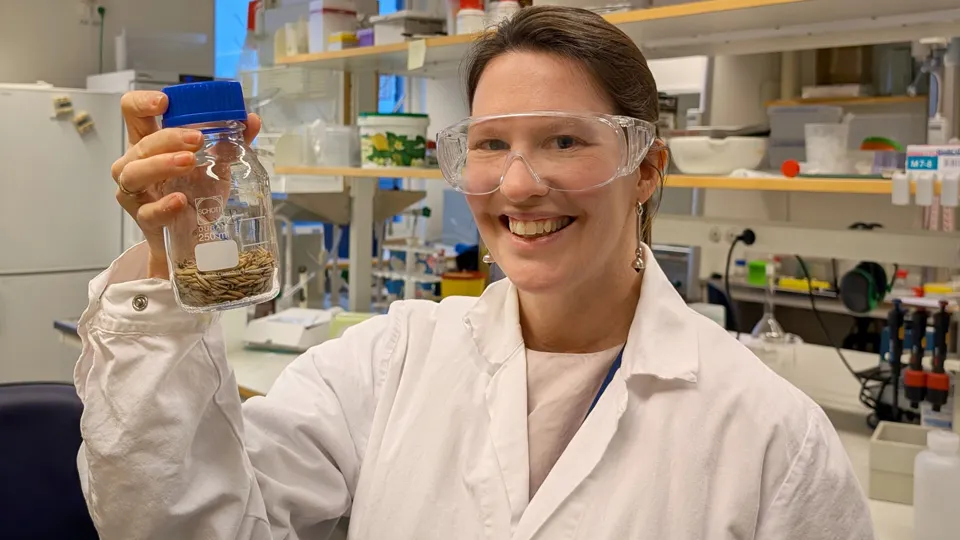
Cecilia Tullberg is an associate senior lecturer in the Division of Biotechnology and Applied Microbiology at Lund University. She’s also leading FORCE, a new centre for food system resilience, aiming to strengthen resilience, sustainability and competitiveness within the food value chain in Sweden.
“I have big hopes for what we can create together in Biotech Heights! By testing things, we can identify new solutions,” says Cecilia Tullberg. “For a farmer or a small actor, it is not always so easy to take risks. With our work we can inspire companies by showing what might be possible if academia and industry collaborate on upscaling or the use of waste streams.”
Her research is focused on lipids (a diverse group of organic compounds such as fats, oils, and waxes that are essential for all living organisms) and on enzymatic processes with a special focus on the digestive system. In recent years, she has explored ways to extract lipids from different side streams produced in oat milk production or in the fish or cereal industries.
“Our overall aim is to make new and more nutritious foods, while using ingredients that we today throw away because we have no use for them.”
Collaboration with the fish industry
One example is her work in collaboration with the fish industry, where a lot of omega-3 lipids found in side-streams such as the head, tail and backbone are currently wasted. She and her colleagues have developed a new enzyme technology-based method to stabilize omega-3 rich oils. This might help extending the shelf-life of these sensitive lipids, while making use of production waste.
Developing polar lipids from side streams
Another example is her and her colleagues’ work on polar lipids. Polar lipids are fat molecules that play an important role in the brain and for cognitive health and have anti-inflammatory properties. Polar lipids are commonly used as food additives to stabilise texture and increase shelf-life.
“Polar lipids have many interesting properties. They have been shown to have a delayed effect on digestion and can help control appetite. They can also be used to create the right texture, such as creaminess, in new types of foods. This is an important aspect to make them more attractive for consumers.”
Currently, polar lipids are neither widely extracted nor added to plant-based products.
“If we could produce polar lipids from different underutilised side streams, we could incorporate them into meat-analogues, for example. They can also work as gelling agents, and help us create the right texture.”
In comparison to alternative proteins, the role of lipids in plant-based foods is still understudied – even though their nutritional benefits are becoming increasingly recognised.
“Lipids are essential for taste because they give the protein its flavour and texture. In our work, we are aiming to show how lipids can greatly improve new and more sustainable types of foods.”
Finding synergies between research on lipids and biotechnology
In the future, Cecilia Tullberg is eager to merge her research on lipids with biotechnology – for example, by exploring the role of specific lipids in new ingredients produced through enzyme technology or fermentation.
In all of her research projects, she’s driven by curiosity – and by the interaction with people. Arriving at solutions together, discussing science, and overcoming challenges in an interdisciplinary environment makes her passionate about her job.
“That I became a researcher was in some ways a lucky coincidence: I am a naturally curious person. Through my work as a researcher I get to work with so many talented people, especially all the students. That brightens my day!”
Read more about Cecilia Tullberg in the Lund University Research Portal



Join us in unlocking the potential of biotechnology.
We are looking forward to new partnerships.
Connect with us to collaborate.

Subscribe to our newsletter
Get the latest updates, news and events from Biotech Heights.
We issue the newsletter 5-7 times a year.